REVIEW · VENICE
The Heart of Venice: A Self-Guided Audio Tour
Book on Viator →Operated by VoiceMap Audio Tours · Bookable on Viator
Venice gets a personal voice. This self-guided GPS audio tour takes you from Piazza San Marco to Rialto Bridge, and the audio starts automatically at each spot you reach. I love that it works with offline audio and maps, so you can keep walking without worrying about data.
You also get a simple, story-first route that ties major landmarks to real Venetian moments, from Carnival to the tide forecasts behind acqua alta. One thing to consider: you’ll need your own smartphone, since the tour includes the VoiceMap app and offline files, but not the device.
In This Review
- Key highlights worth your time
- A self-guided Venice audio walk from San Marco to Rialto Bridge
- VoiceMap with offline audio, maps, and geodata
- How the GPS triggers work while you wander
- Piazza San Marco: the Piazza that hosted empires and drama
- Campo San Salvador and the 1898 column of revolt
- Teatro Comunale Carlo Goldoni: comedy that sounded like real people
- La Fenice opera house: where Rigoletto and La Traviata began
- Palazzo Cavalli and Centro Maree: tides, weather, and acqua alta
- Rialto Bridge: from wooden bascules to what you see today
- Price and value: $11.99 for an hour of auto-guided stories
- When to do it, and how to fit it into your day
- Should you book The Heart of Venice self-guided audio tour?
- FAQ
- How long is the Heart of Venice self-guided audio tour?
- Is the tour available in English?
- Does it require an internet connection?
- Where does the tour start and end?
- Do I need to bring a smartphone?
- Can I cancel for free?
Key highlights worth your time
- GPS-triggered audio: the narration plays when you reach each location, so you can keep exploring your way
- Offline access included: audio, maps, and geodata are available without mobile data
- A compact route: about 1 hour from San Marco to Rialto Bridge
- Real Venice stories, not just facts: popes, emperors, executions, Carnival, and the 1848–1849 revolt
- Operas and theater in the mix: La Fenice and Carlo Goldoni’s comedic revolution show up in the walk
A self-guided Venice audio walk from San Marco to Rialto Bridge
If you want Venice with a little structure but zero babysitting, this is built for that. You’re not joining a group that tells you when to stop. Instead, you follow a GPS path with a voice guide that kicks in as you arrive at each key point.
The route focuses on the heart of the city. You start at Piazza San Marco, then work toward Rialto Bridge. Along the way, you’ll hear stories connected to politics, theater, opera, and even the science behind tides.
And because it’s self-guided, the pace is yours. If you linger on a detail in one square, you don’t feel like you’re falling behind a tour guide’s schedule. The “about an hour” timing also makes it easy to slot into a day without over-planning.
You can also read our reviews of more guided tours in Venice


VoiceMap with offline audio, maps, and geodata
This tour runs through the VoiceMap application. What matters for your trip is the offline package. You get offline access to audio, maps, and geodata, so you’re not forced into constant data use.
That’s a big deal in Venice. Even if you do have service in some places, navigation can still be spotty. With offline maps and geodata, you can focus on walking and listening instead of troubleshooting your phone.
Another plus: you get lifetime access to the Heart of Venice tour. That means you can replay it later, or use it as a refresher if you come back to the area.
One more practical note: the app and offline content depend on your phone. The experience doesn’t include a smartphone, so plan to travel with a charged device and whatever settings you normally use for audio.
How the GPS triggers work while you wander
The tour is designed around a simple idea: you reach a stop, and the audio plays automatically. You don’t have to keep pressing buttons like you’re running a video game.
That also changes how you move. To get the most from it, you’ll want to walk between stops at a steady pace, not in huge jumps. If you stop for a long time, you’ll hear that stop’s story when you arrive—and then you’ll wait for your next arrival before new audio begins.
The included directions to the starting point help here. You’re not left guessing where to begin once you’re in the area. Start location is listed as P.za San Marco, 328, 30124 Venezia VE, Italy, and the tour ends at Rialto Bridge (Ponte de Rialto, 30100 Venezia VE, Italy).
Duration is listed as about 1 hour, so you’re aiming for a “steady, listen, walk, repeat” rhythm.
Piazza San Marco: the Piazza that hosted empires and drama
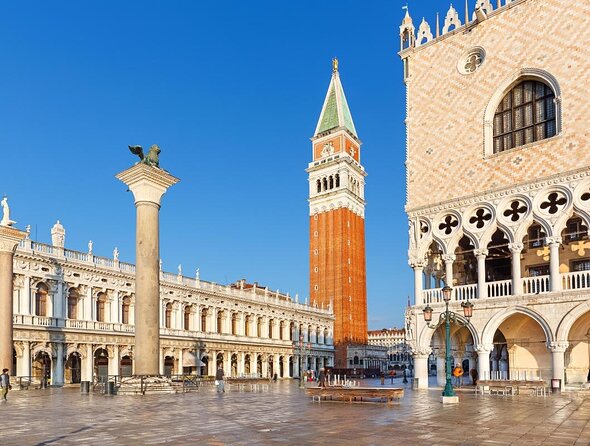
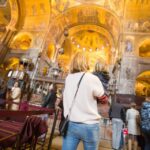
Piazza San Marco is the starting center of gravity for the whole experience. It’s described as the most famous and central point of Venice, and the one that visitors have come to for roughly the last thousand years.
In the audio, you’ll hear how this place has been a stage for big moments. It was once called the drawing room of Europe, but Venetians simply call it the Piazza. The stories you’ll get aren’t quiet museum snippets. This is where state visits of popes and emperors happened. It’s also tied to public executions, religious processions, and Carnival—the kind of high theater that fits Venice perfectly.
Why that stop is worth your attention: it teaches you what you’re looking at. When you understand Piazza San Marco as a long-running stage for drama, it’s easier to connect the physical space to the feel of the city.
A practical consideration: since this is the most famous hub, it’s the kind of place where you might want a careful moment before you start listening—so you know you’re in the correct spot and can let the audio take over.
Campo San Salvador and the 1898 column of revolt
Next you’ll head to Campo San Salvador. The highlight here is a tall marble column standing in the middle of the square. It was set up in 1898, and the purpose is straightforward and intense: it commemorates the 17-month Venetian revolt against Austrian occupation in 1848 and 1849.
This stop changes the tone. Instead of focusing on spectacle like Carnival, you get a direct reminder that Venetian history includes resistance, not just celebration.
What I like about this as a listening stop is how it adds depth to what you might otherwise treat as a postcard-only landscape. The column becomes an anchor for a specific period, and you’re guided to look at the square through that lens.
A small pacing tip: since the column sits centrally, you’ll likely have a clear view from the surrounding area. That makes this stop ideal for listening without needing to constantly reposition.
You can also read our reviews of more tours and experiences in Venice





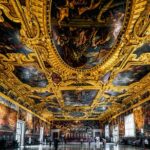
Teatro Comunale Carlo Goldoni: comedy that sounded like real people
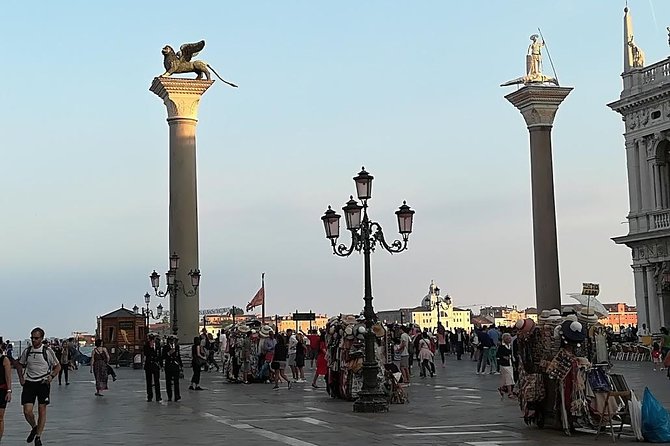
The route then shifts into theater territory at Teatro Comunale Carlo Goldoni. The building carries the name of Carlo Goldoni, a Venetian playwright from the 1700s.
The key story is what Goldoni changed. He wrote many comedies in the Venetian dialect. That mattered because it was revolutionary for its time. The audio also notes that he made characters feel like real people, highlighting the quirks of ordinary Venetians.
Why this works on a self-guided audio walk: it gives you a new way to think about language and culture. Venice isn’t only canals and stone. It’s also speech, humor, and the way people saw themselves.
If you’re the type who likes art with a social angle, this stop is a strong payoff. The story isn’t just who Goldoni was. It’s what he did to make theater feel more like life.
La Fenice opera house: where Rigoletto and La Traviata began
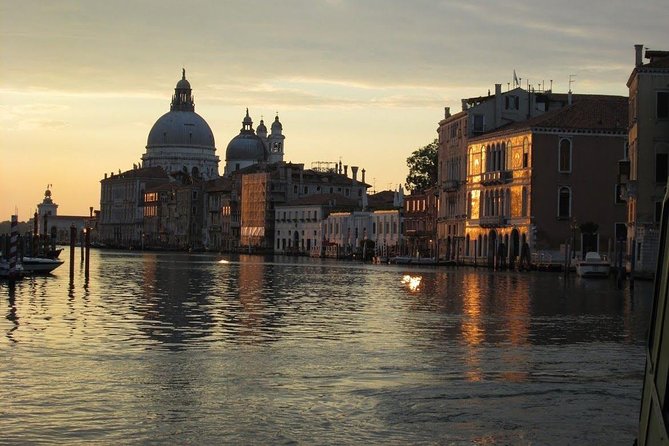
Another major arts stop follows: La Fenice. Many famous operas had their first performance here, including Rigoletto and La Traviata. And even though the tour is self-guided, the message stays clear: La Fenice is still one of the most important opera houses in Italy.
This is a great moment in the route because it connects “names you already know” to a real place in the city. If you’ve heard those opera titles before, the audio framing helps you locate their origins in Venice, not just in history books.
A practical note for your listening: opera-house stories tend to reward attention to details. Since this tour plays automatically at arrival, let the narration start and then watch how the building and surroundings match the tone of what you’re hearing.
Palazzo Cavalli and Centro Maree: tides, weather, and acqua alta
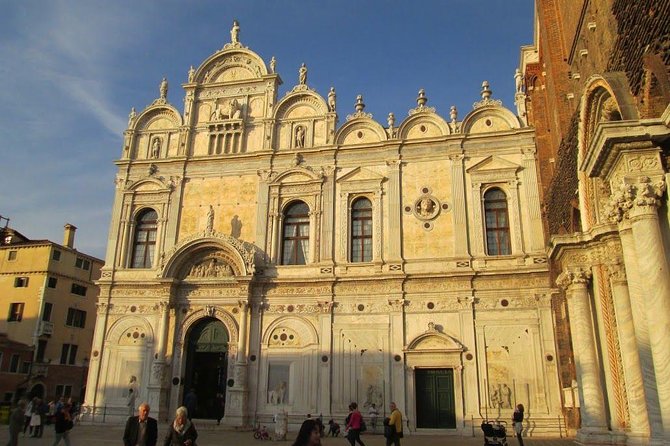
Palazzo Cavalli is where things get practical in a very Venetian way. It’s where civil marriage services are conducted. The building also houses the Centro Maree, also called the Tide Center.
This is the place where monitoring data about tides and weather takes place. The daily tide predictions are made here—especially predictions regarding high tide, referred to as acqua alta.
That’s a fascinating twist for a walk that otherwise centers on monuments and art. You’re reminded that Venice is a living city with systems that watch water levels every day.
Why it’s valuable: it shows Venice as a place that plans for its environment. The tide stories aren’t abstract. They’re tied to real monitoring and daily predictions.
Possible drawback: this stop may feel less visually dramatic than the big squares and famous bridges. If you’re hoping for purely eye-candy sightseeing, lean into this moment for the story side. It’s one of those stops that makes the city make sense.
Rialto Bridge: from wooden bascules to what you see today
You’ll finish at Rialto Bridge, one of Venice’s biggest “you can’t miss it” sights. The audio focuses on how the bridge you see fits into a longer engineering story.
Rialto is described as the third bridge of its kind. Earlier Rialto bridges were made of wood. They were bascule bridges, meaning the center part could be raised to allow ships with masts to pass through.
That historical detail matters because it turns the bridge from a static photo spot into a functional piece of city design. The route ending doesn’t just hand you a famous landmark—it explains why the landmark had to change as Venice’s needs changed.
If you like seeing how practical needs shape what survives, this finish lands well. You go out with a clear idea of how trade and movement affected infrastructure.
Price and value: $11.99 for an hour of auto-guided stories
At $11.99 per person for about 1 hour, you’re paying for a few things that are hard to replicate for free during a solo walk: guided audio narration, GPS-triggered timing, and offline access to audio, maps, and geodata.
Lifetime access also boosts value. This isn’t a “one-and-done” experience you lose as soon as you finish. You can replay it later, or revisit parts of the route if you want another pass through the stories.
Also, the tour is described as a private activity, meaning it’s just your group. In practice, that fits the self-guided concept: you’re not waiting on other people or trying to keep up with a pace you didn’t choose.
One more value angle: the route is compact. Starting at San Marco and ending at Rialto means you’re not piecing together multiple tours. It’s one walk with clear anchors and an audio brain attached.
If you plan to visit on certain dates, note that day visitors staying outside Venice may face a €5 access fee on some dates. You’ll want to check the details for applicability at the official link provided with the tour info.
When to do it, and how to fit it into your day
You can do this anytime during the listed opening hours window. The experience itself runs essentially all day (Monday through Sunday is listed as 12:00 AM to 11:59 PM), and confirmation is available at booking.
Because the duration is about an hour, I like using it as a “foundation walk.” You can do it early to learn the stories, then return later in the day with your head full of context. Or do it mid-day as a structured break that still lets you move on your own.
It also pairs well with other walking plans because it ends in a major hub. Once you reach Rialto Bridge, you’re in a natural place to continue exploring without changing modes or backtracking.
Should you book The Heart of Venice self-guided audio tour?
Book it if you want Venice with independent pacing but still want a guide’s structure built into the experience. This is a smart fit if you like learning through stories—political drama in San Marco, revolt memory in Campo San Salvador, theater culture at Teatro Comunale Carlo Goldoni, opera connections at La Fenice, and even water science at the Centro Maree.
Skip it or weigh it carefully if you don’t want to rely on a phone during your sightseeing. The experience needs the VoiceMap application on your smartphone, and the tour does not include a phone.
One last decision help: if you’re the type who gets more out of a place when you can pause, look around, and then keep going without negotiation, this setup is built for you.
FAQ
How long is the Heart of Venice self-guided audio tour?
The tour lasts about 1 hour.
Is the tour available in English?
Yes, the tour is offered in English.
Does it require an internet connection?
No. It includes offline access to audio, maps, and geodata, so you don’t need data.
Where does the tour start and end?
It starts at P.za San Marco, 328, 30124 Venezia VE, Italy, and ends at Rialto Bridge (Ponte de Rialto, 30100 Venezia VE, Italy).
Do I need to bring a smartphone?
Yes. A smartphone is not included, but you’ll need it to use the VoiceMap application.
Can I cancel for free?
Yes. You can cancel up to 24 hours in advance for a full refund.