REVIEW · VENICE
Lido Bike Tour: With a Local on the Island of Cinema
Book on Viator →Operated by deTourist Venice Valerio Coppo · Bookable on Viator
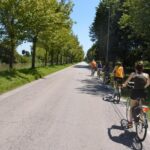
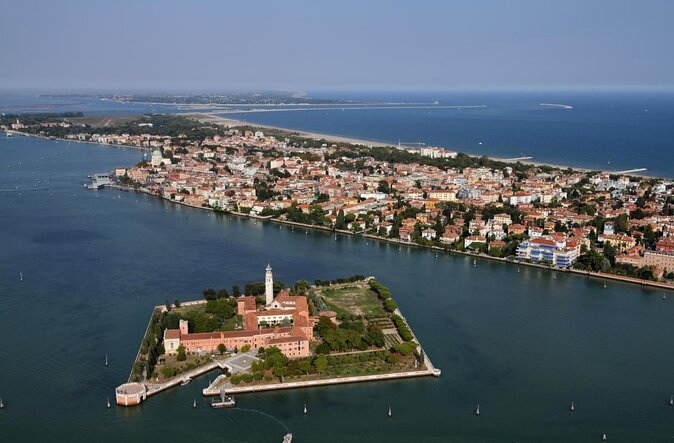
Venice, but make it slower. This bike tour across Lido di Venezia trades crowded streets for canals, forest paths, and classic film-festival settings. You’ll ride with Valerio Coppo, meet at Santa Maria Elisabetta, and cover a surprising mix of sights: Jewish history, grand hotel glamour, wild coastline, and the lagoon’s story-heavy islands.
I love how the route stays practical. You get to see major Lido highlights without wasting time on busy roads, and the guide keeps the pace easy enough for a moderate ride. I also like that it’s packed with variety—cemetery art, a lighthouse viewpoint, big-screen landmarks, and beach time in one afternoon.
One thing to consider: the surfaces can be a bit rough in spots, including sandy or uneven stretches. If you’re on the fence about tires, ask for wider tires; it can make the trip feel much more comfortable.
In This Review
- Key moments worth penciling in
- Getting Oriented Fast: Why Lido by Bike Works
- Meeting at Santa Maria Elisabetta and Picking the Right Bike
- Jewish Cemetery to San Nicolo: Lido’s Quiet, Art-Heavy Side
- Faro di San Nicolò: The Lighthouse View That Reframes Lido
- Cinema on the Move: Grand Hotel des Bains to Mostra del Cinema
- Murazzi and Free Beach: Breakwater Engineering Meets Open Air
- Alberoni Dunes: Pine Forest Quiet and a More Wild Beach Mood
- Malamocco: Canals, Calli, and the Small-Village Scale
- Poveglia and Lazzaretto Vecchio: The Lagoon’s Dark Stories
- San Lazzaro degli Armeni and Ausonia & Hungaria: Faith and Facades
- Price, Timing, and Group Size: What You’re Really Paying For
- Who This Tour Fits Best
- Should You Book the Lido Bike Tour?
- FAQ
- Where does the tour start?
- How long is the Lido bike tour?
- Is the bicycle included in the tour price?
- What bike types are available to rent?
- What language is the tour offered in, and what’s the group size?
- Are entrance fees included for the stops?
- Is there a weather backup, and can I cancel for a refund?
Key moments worth penciling in
- Valerio Coppo runs the show and adjusts the biking to your group’s comfort level
- Cinema connections on Lido including grand hotels tied to major film stories
- Protected nature + canal routes instead of grinding through Venice traffic
- Murazzi breakwater coastline with sea views and a classic lagoon engineering story
- Alberoni dunes where the beach can feel almost empty, plus lots of bird life
- Lagoon islands with heavy backstories like Poveglia and Lazzaretto Vecchio
Getting Oriented Fast: Why Lido by Bike Works

Lido is Venice’s long, linear breathing space. It’s where you go for beaches, but also for history you can’t fully appreciate from a ferry seat. By bike, you get movement and context at the same time: you’re not just seeing places, you’re traveling between them.
The big win here is rhythm. The tour is structured around short stops—enough time to learn what you’re looking at—then you ride on while the setting changes. That matters on Lido, because the island shifts from waterfront to pine forest to quiet villages pretty quickly.
Another practical plus: you’re not stuck with one view forever. The ride is designed to help you catch coastline angles, lagoon-side perspectives, and the outlines of famous hotel façades from the right direction.
You can also read our reviews of more cycling tours in Venice


Meeting at Santa Maria Elisabetta and Picking the Right Bike
You start at Santa Maria Elisabetta on Lido, near the water-taxi area. From there you’ll rent your bike as part of the experience setup—the booking and organization are handled for you.
Bike choice is not a small detail on this tour. The rental options listed are city bike, tandem, e-bike, fat bike, and e-fat bike, with different prices depending on what you choose. City bikes are the simplest option, but if you’re worried about sandy or uneven paths, wider tires (fat bike or e-fat bike) can make the ride feel smoother. One rider even suggested wider tires for the route and that advice tracks with the mix of shore paths and rougher sections you’ll encounter.
Don’t overthink the fitness part. The tour calls for moderate physical fitness, and the guide can adjust to the group’s ability. If you’re not a cyclist at home, that matters. You’ll still get a real outing—just not a punishment.
Jewish Cemetery to San Nicolo: Lido’s Quiet, Art-Heavy Side
Your first history stop is the Cimitero Ebraico. Today it’s calm and garden-like, but it used to be Venice’s main Jewish cemetery from 1386 until the 18th century. From the gate, you can see tombs with designs ranging from Venetian gothic to styles with distinctly Ottoman influences.
It’s the kind of place where a short visit actually works. Because you’re on a bike schedule, you see what you need and you keep moving, but the guide’s context helps the cemetery stop feeling like a photo opportunity. You come away understanding that Lido has always been part of Venice’s wider world, not only its entertainment layer.
Next is Chiesa Di San Nicolo Al Lido, tied to the traditional thanksgiving mass of the Sposalizio del Mare. This ceremony used to symbolize Venice’s maritime dominion—basically the island’s church life connected directly to Venice’s sea power. The stop is brief, but the meaning is big, especially if you like places where religion and daily politics once overlapped.
Faro di San Nicolò: The Lighthouse View That Reframes Lido
After biking through protected natural zones, you’ll reach Faro di San Nicolò. The ride continues along an old pier between the sea and the harbour mouth, then up to the lighthouse area.
This stop is a good example of why cycling adds value here. From the lighthouse approach, you can look out over the Lido coastline and also catch the outlines of major hotels—Grand Hotel des Bains and Hotel Excelsior—in your sightline. You’re not just standing at a random viewpoint. You’re seeing how the island’s buildings sit against the water.
If you’re the type who likes practical sightseeing, this is also a great photo setup moment. The guide helps you position yourself and understand what you’re looking at, which saves time later when you’re trying to match shapes to stories.
Cinema on the Move: Grand Hotel des Bains to Mostra del Cinema
Now you get to the part that makes this tour feel different from a basic Lido ride: the film-festival trail. The tour doesn’t treat cinema like trivia. It treats it like geography—the way the venues and hotels shape what you see today.
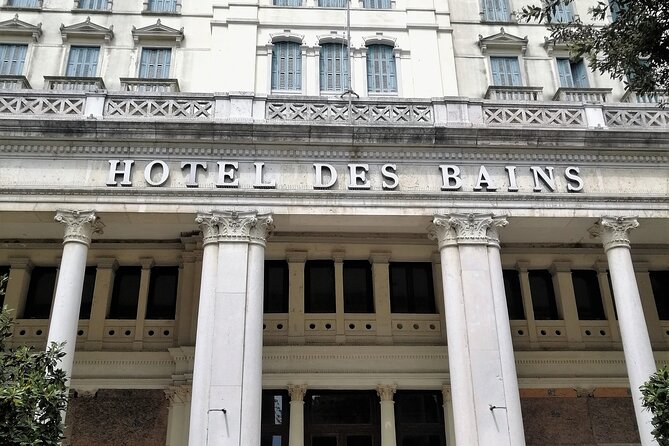
You’ll stop at Grand Hotel des Bains, a former luxury hotel built in 1900 to attract wealthy visitors. It’s remembered for Thomas Mann’s stay in 1911, and for film scenes connected to Death in Venice by Visconti (1971) and The English Patient (1996). Even if you’ve only watched one of those, the stop gives you a concrete way to connect Lido to screen history.
From there you’ll move to Ristorante Mostra del Cinema, located near the Palazzo del Cinema area where the Mostra del Cinema is held in late August or early September. The tour also points out how Hotel Excelsior (1908) fits into the festival world, often hosting producers and actors during that season.
One detail I really like: the stops are timed so you’re not trapped in the thick of festival crowd energy. You get the cinema references, then you get back on the bike and see how the rest of the island lives beyond the red-carpet dates.


Murazzi and Free Beach: Breakwater Engineering Meets Open Air
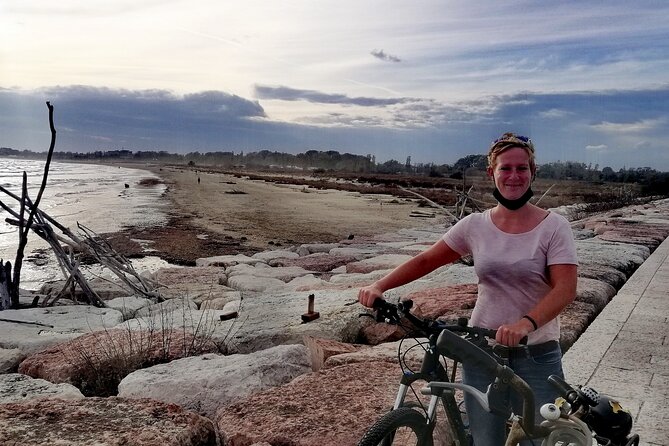
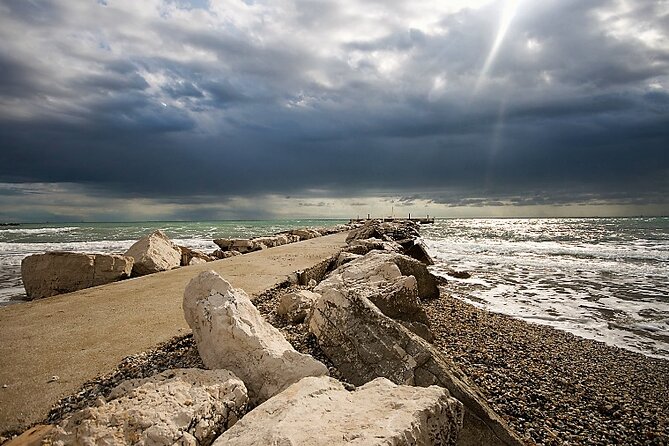
When the tour heads toward the Murazzi, you’ll ride along a scenic stretch following the Adriatic Sea. The Murazzi are an 18th-century engineering work designed to keep high seas from crashing into the lagoon. Even today, the logic of the barrier is still part of the view.
This is one of the best parts for anyone who loves learning while moving. The sea is right there, but the guide connects what you see to why it’s shaped the way it is. It turns an easy waterfront ride into a real understanding of how Venice protects itself.
Then you’ll enjoy the Murazzi Free beach area as part of the route. It’s a reminder that Lido isn’t only about landmark buildings and festival halls. It’s also a working coastline, with the sea doing what it does.
Alberoni Dunes: Pine Forest Quiet and a More Wild Beach Mood
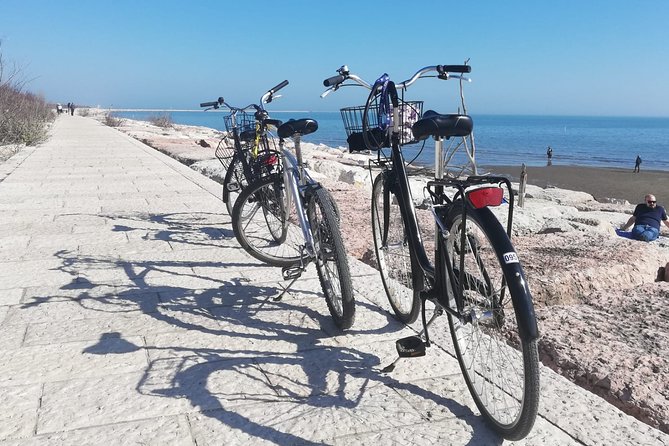
Next comes L’Oasi delle Dune Alberoni, the natural beach of Alberoni with a maritime pine forest leading down to the wildest stretch of Lido’s coastline. The dune fields are described as inspiring for poets like Shelley and Byron, and that vibe shows in how the setting feels: wind, birds, and open space.
This is the part of the ride where you’re likely to get that rare break from the sightseeing mindset. Often this beach is virtually deserted, except for marine birds and the occasional kite surfer or windsurfer on windy days. Even if you’re not thinking about poetry, you’ll feel the difference between city-leaning Venice and this side of the island.
A practical note: if you chose a bike that’s a bit lighter and you hit sandy sections, be ready for slower moments. Walk your bike when you need to. That’s not a failure. It’s just smart riding.
Malamocco: Canals, Calli, and the Small-Village Scale
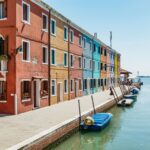
After the dunes, the ride moves toward Malamocco, a small fisherman village on Lido. You’ll cross over Ponte di Borgo, then explore canals and calli at a pace that doesn’t feel overwhelming.
What I like about this stop is the scale shift. Malamocco doesn’t try to compete with Venice’s grandeur. Instead, it feels like a “mini Venice,” with just a few churches and a Gothic palazzo that gives you the style without the overload.
This is also where the bike tour pays off again. On foot or by transit, you might miss the connective tissue—those canal turns and side streets. On a bike, you naturally follow the layout and you actually see how the village breathes.
Poveglia and Lazzaretto Vecchio: The Lagoon’s Dark Stories
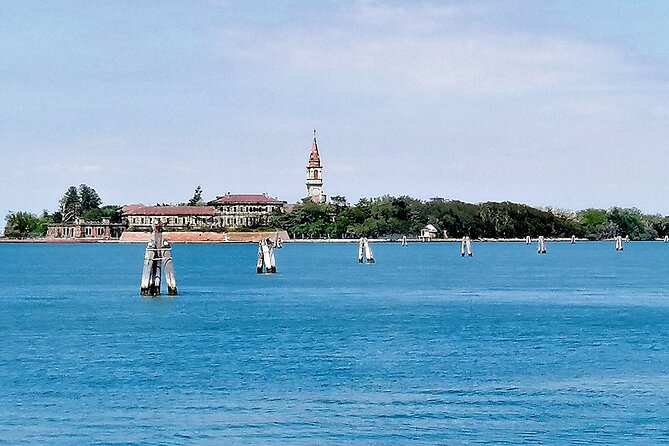
Now you head to the lagoon side with views toward Lazzaretto Vecchio and the broader island network. Two of the most talked-about places on this stretch are Poveglia and Lazzaretto Vecchio, and both come with heavy themes.
On Poveglia, the story goes back to 1776, when the island was used as a quarantine station for people suffering plague and other diseases. Later it became a mental hospital, and it closed in 1968. The island is frequently featured in paranormal shows, so you’ll likely hear that association in the guide’s explanation—but the real weight here is the medical and isolation history.
Lazzaretto Vecchio is close by in story and setting. It housed a hospital caring for people during plague epidemics between 1403 and 1630, then later served as a leprosarium. After that, it was used as a military post.
These are short stops, but they’re the kind that stay with you. You don’t need a long lecture. You just need context so the empty-feeling places start making sense.
San Lazzaro degli Armeni and Ausonia & Hungaria: Faith and Facades
Next is San Lazzaro degli Armeni, another lagoon-side stop with views toward the island of San Lazzaro degli Armeni. The focus here is the monastery of the Mekhitarists, an Armenian Catholic congregation, which has been there since 1717.
This is a quieter counterpoint after the darker stories. It helps you see the lagoon not as only a place of illness and isolation, but also as a place where religious communities lived and continued for centuries.
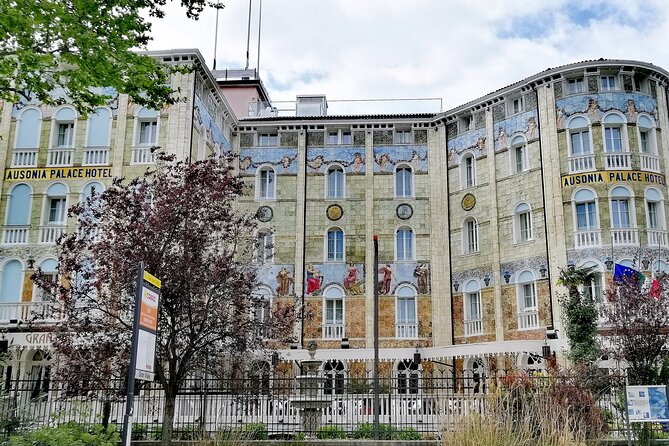
You’ll wrap with Grande Albergo Ausonia Hungaria (Hotel Ausonia & Hungaria), built in 1913 and known for its ceramic-tiled façade. It’s recently renovated, and it’s another reminder that Lido has always attracted people seeking comfort—sometimes in leisure, sometimes in care, sometimes in both.
Price, Timing, and Group Size: What You’re Really Paying For
At $203.50 per person for about 4 hours 30 minutes, you’re paying for a guided interpretation of a compact but varied island. The tour includes a nature and interpretive guide plus organization of rental bikes if needed.
Bike use itself is not included. That means your total cost depends on your bike choice. The rental options listed include city bikes, tandems, e-bikes, fat bikes, and e-fat bikes, with different prices per bike type. In one real-world example, a rider shared that the bike rental came out around 12€ per person for the bike they chose, and felt reasonable. So yes, bike costs matter—but the setup and guidance here are part of what makes the day work.
The small group size helps a lot. With a maximum of 10 people, the pace and safety feel more controlled than on big bus-style tours. You’ll also be more likely to get personalized attention if you need a slower stretch or want help choosing a bike style that matches the route.
Timing-wise, it’s a great afternoon length. Long enough to feel like a real excursion off the main Venice loop, short enough that you can still eat well afterward and not feel wrecked before sunset.
Who This Tour Fits Best
This tour fits you if you want Lido to feel like a place you understand, not just a stop you pass through. It’s ideal for people who like guided context and for cyclists who want variety: cemetery art, lighthouse views, grand hotel cinema stories, beach dunes, and lagoon islands.
It also fits beginners who aren’t trying to win a race. The route is described as manageable with moderate physical fitness, and the guide can adapt to your group’s biking comfort.
If you want a gentle, purely flat ride with no rough spots at all, this might feel slightly more adventurous than you want. But with the right bike choice—especially wider tires if you’re sensitive to bumps—the route becomes much more comfortable.
Should You Book the Lido Bike Tour?
If you’re planning a Venice trip and you want more than postcard Lido moments, I think this is a smart booking. You get cinema-linked landmarks, beach-and-dune nature, and lagoon history in one guided loop, and you do it with small-group pacing that keeps the day from feeling rushed.
Book it if you like guided storytelling and you’re okay with occasional rough or sandy ground. Skip it if you only want a very smooth, low-effort stroll day. Otherwise, it’s one of the more satisfying ways to see Venice’s most cinematic island at human speed.
FAQ
Where does the tour start?
You meet at Santa Maria Elisabetta, 30126 Venice, Metropolitan City of Venice, Italy.
How long is the Lido bike tour?
It runs for about 4 hours 30 minutes.
Is the bicycle included in the tour price?
No. The tour includes bike rental organization if needed, but the use of the bicycle itself is not included.
What bike types are available to rent?
Bike options listed include a city bike (10€), tandem (20€), e-bike (20€), fat bike (18€), and e-fat bike (30€).
What language is the tour offered in, and what’s the group size?
The tour is offered in English, and it has a maximum group size of 10 travelers.
Are entrance fees included for the stops?
All listed stops show Admission Ticket Free, so you don’t need to plan entrance fees for them.
Is there a weather backup, and can I cancel for a refund?
The experience requires good weather. If it’s canceled due to poor weather, you’ll be offered a different date or a full refund. There is also free cancellation up to 24 hours in advance for a full refund.